
V300 Rubber Fender 2000-Ton Pressure Testing
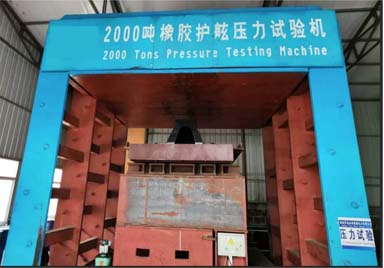
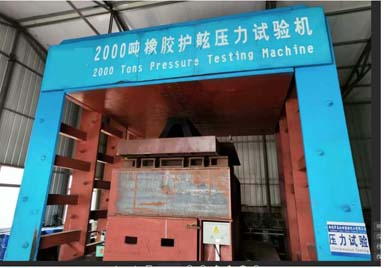
Recently, a domestic port protection equipment manufacturer completed a full-scale compression destructive test on a 2000-ton large-scale rubber fender dedicated pressure testing machine. The test fully verified the fender's buffer energy absorption, structural stability, and ultimate pressure bearing capacity. All product indicators meet international port engineering standards.
The test sample was a V300 type V-type rubber fender with the following specifications: H300mm, W600mm,L 1000mm, and L 1150mm.
Complete Test Process
1. Pre-Test Preparation
The V300 V-type rubber fender was stably and centrally placed in the center of the pressure-bearing base of the 2000-ton pressure testing machine. The limiting device was fixed, the hydraulic control system was connected, the pressure acquisition and displacement recording equipment was adjusted, and the test loading rate was set to ensure real-time data recording.
2. Uniform Speed and Graded Pressurization Stage:
Pressure is applied uniformly downwards from the upper pressure plate of the testing machine, with progressive loading according to international fender testing standards. In the initial stage, the V-shaped opening of the fender slowly closes, and the rubber body deforms uniformly under pressure. The equipment simultaneously records the reaction force, compression amount, and energy absorption values. Throughout the process, the fender surface is observed, with no cracking, delamination, or localized bulging.
3. Rated Working Pressure Test:
When the rated design compression amount is reached, the V-shaped structure fully contracts, relying on the arc-shaped rubber structures on both sides to disperse the impact force. The measured reaction force is stable, and the energy absorption meets the design standards, satisfying the berthing buffer requirements for ships at the dock.
4. Ultimate Overload Pressure Test:
The load is further increased, continuously increasing the compression stroke until the ultimate compression state is reached. The overall fender structure remains intact, with no breakage, tearing, or core failure issues. After unloading, the fender quickly rebounds, restoring its original shape, and the permanent deformation is far below the international standard limit.
5. Test Completion:
Slowly depressurize, remove the sample, check its appearance integrity, compile the pressure-deformation curve, energy absorption data, and permanent deformation data, archive all test data, and issue an authoritative test report.
E-mail : info@whalefender.com
Website : www.whalefender.com


Copyright © Whale Marine Product Co.,Ltd. All Rights Reserved | Sitemap| Powered by 