
Strict packaging specification to prevent coating damage
Steel mooring bollards are core berthing fittings for ports, terminals and vessels. The product adopts a high-performance C5-grade anti-corrosion coating system. The coating is hard-wearing for long-term marine corrosion resistance, yet vulnerable to chipping, scratching and peeling under impact, friction and collision in the whole logistics chain, especially during sea freight, container loading and unloading, transshipment and destination port handling.
Damaged coating will trigger on-site re-painting work at destination, which brings extra labour cost, delivery delay and inspection risks. To guarantee intact coating condition upon arrival, the factory has formally implemented standardized packaging procedures for all finished mooring bollards, with clear packaging requirements and anti-collision protection measures.
Item | Specification |
Corrosion Protection Class | C5 C5-H is recommended for marine exposure environment |
Surface Preparation | SA2.5 blast cleaning: No visible oil, grease, scale, rust, old paint and contaminants; minor stains ≤5% per square meter are acceptable |
Primer | Zinc-rich epoxy coating, dry film thickness: 120 μm |
Intermediate Coat | Epoxy coating, dry film thickness: 120 μm |
Topcoat | Polyurethane topcoat, dry film thickness: 120 μm |
General Paint Requirement | Black finish; total dry film thickness ≥350 μm |
The finished bollards are fully cured after painting, but the outer polyurethane topcoat cannot withstand sharp impact and hard friction. Conventional bulk loading without protection will inevitably cause local paint chipping during sea transportation. Therefore, the packaging flow is divided into inner protective wrapping, intermediate cushioning, outer wooden case packaging, and acceptance check before shipment.
1. Pre-packaging Inspection
Before wrapping, inspect the whole surface of each mooring bollard. Confirm the paint film is fully cured, free of pinholes, sagging, blistering and existing scratches. Any defective piece shall be reworked and re-inspected before packaging. No unqualified coated products are allowed to enter the packaging process. Mark the SWL (Safe Working Load) and batch number on the flange for traceability.
2. Primary Surface Wrapping – Stretch Protective Film
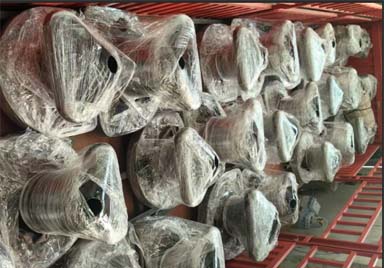
Each single bollard shall be individually wrapped with transparent stretch plastic film. The wrapping covers the entire bollard head, curved surface and flange, with 3–5 overlapping layers. The film should be tightly attached without loose bubbles. The purpose is to isolate dust, seawater mist and minor surface friction, and serve as the first barrier to prevent direct scraping of the paint layer. Sharp edges and bolt holes on the flange shall be wrapped with extra layers to avoid edge chipping.
3. Secondary Cushioning – Anti-collision Foam / Bubble Wrap
After stretch film wrapping, all protruding parts, arc top of the bollard and flange edges must be additionally padded with thick bubble wrap or EPE anti-collision foam. The foam shall fully wrap the high-risk impact areas. Contact points between two bollards (if multiple are packed in one crate) must be separated by foam sheets, eliminating hard-on-hard contact. No metal surface shall be in direct contact with another bollard or wooden case.
4. Outer Packaging – Export Plywood Wooden Case
· Material: Use export non-fumigation plywood cases, meet international sea freight container packing standards, no pest risk, suitable for direct export.
· Case structure: The crate is designed with reinforced battens at corners and edges to resist extrusion and impact during stacking and lifting. The inner dimension reserves enough clearance for foam cushioning around the bollard.
· Fixing: Inside the wooden case, the bollard shall be firmly fixed with wooden supports and strapping belts. The strapping contact points must be padded with foam, and the straps cannot directly press against the painted surface, to prevent shifting and shaking in transit.
· Quantity control: Control the loading quantity per crate reasonably, avoid overcrowding and extrusion.
5.Case Marking & Shipment Labeling
Each wooden crate shall be printed with permanent shipping marks: Item Name (Mooring Bollard), SWL, Quantity, Gross Weight, Net Weight, Dimension, PO No., Destination Port. Standard handling symbols shall be marked: Fragile, Handle With Care, Keep Dry, No Stacking on Top.
6.Loading & Container Stowage Requirement
When loading into the sea container, arrange the wooden cases neatly. The gaps between crates shall be filled with foam or air bags to prevent sliding during vessel rolling. Avoid heavy cargo stacked directly on top of bollard crates. Forklift operation must be slow and stable, forbid collision of forks against wooden boxes.
The standardized packaging rule applies to all C5 anti-corrosion painted mooring bollards for export. The manufacturer reminds clients that even with high-grade C5 anti-corrosion paint, the coating is not impact-resistant. Strict execution of this wrapping & wooden case packaging scheme can effectively reduce paint peeling damage, avoid expensive on-site re-coating at destination port, shorten the commissioning cycle for terminal projects and stabilize the delivery quality of marine mooring fittings.


Copyright © Whale Marine Product Co.,Ltd. All Rights Reserved | Sitemap| Powered by 