
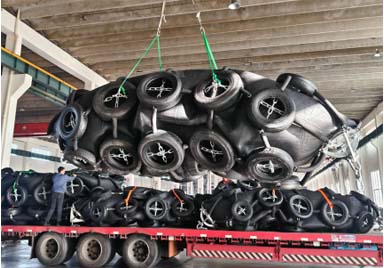
Pneumatic Rubber Fenders Ready for Shipment
A full load of high-performance pneumatic rubber fenders (Yokohama-type fenders) has been completed and loaded onto flatbed trailers at our manufacturing facility, ready for delivery to overseas clients. These inflatable marine fenders serve as a critical safety buffer to prevent hull damage during vessel berthing, unberthing and offshore ship-to-ship (STS) transfer operations.
Pneumatic rubber fenders are constructed from multi-layer reinforced synthetic cord rubber, inflated with compressed air to create a floating, flexible shock-absorbing cushion. Unlike solid rubber fenders, they absorb berthing impact energy through air compression, achieving high energy absorption while maintaining low surface pressure on vessel hulls. This core advantage greatly reduces the risk of paint scratching, hull denting and structural stress for oil tankers, bulk carriers, container ships and offshore platforms.
Item | Specification |
Standard | ISO 17357-1:2014 |
Structure | Outer rubber layer + Synthetic cord reinforcement layers + Inner rubber lining |
Working Initial Pressure | 50 kPa (P50) / 80 kPa (P80) |
Standard Deflection | 60% |
Fender Type | Chain & tyre net type (as shown in picture), Sling type |
Surface Protection | Second-hand tyre protection net / Chain net |
Fitting | Hot-dip galvanized chain, shackles, end flange |
Material | Marine grade rubber, high tensile synthetic cord |
Available Certificates | BV, ABS, DNV, CCS, LR third-party inspection certificate |
Application | STS transfer, vessel berthing, shipyard, temporary berth, offshore platform |
Feature | Floating automatically with tide, low hull pressure, high energy absorption |
Test Items | Air tightness test, pressure holding test, impact compression test |
The batch rubber fender is equipped with heavy-duty galvanized chain and tyre protection nets. The tyre net wrapping protects the rubber body against abrasion from floating debris, sharp contacts and repeated friction; the chain assembly allows convenient hoisting, positioning and rapid deployment at ports or offshore sites. As floating equipment, pneumatic fenders rise and fall automatically with tidal changes, delivering stable protection in locations with large tidal ranges, temporary berths and open-sea transshipment scenarios where fixed quay fenders cannot work properly.
Nominal Size (D × L, mm) | Initial Pressure | Guaranteed Energy Absorption (kJ) | Reaction Force (kN) | Hull Surface Pressure (kPa) |
500 × 1000 | 50 kPa | 6 | 64 | 132 |
600 × 1000 | 50 kPa | 8 | 74 | 126 |
800 × 1500 | 50 kPa | 20 | 145 | 130 |
1000 × 2000 | 50 kPa | 45 | 257 | 132 |
1200 × 2000 | 50 kPa | 64 | 325 | 132 |
1500 × 3000 | 50 kPa | 153 | 579 | 132 |
1700 × 3000 | 50 kPa | 205 | 710 | 132 |
2000 × 3500 | 50 kPa | 320 | 930 | 132 |
Note: P80 version has higher energy absorption and reaction force. Custom dimensions are available upon request.
Lightweight for handling, easy to inflate, deflate and relocate, this type of fender is a versatile, cost-effective marine protection solution. Our team provides full technical support including size selection, pressure guidance, inspection certification and customised configurations for different vessel tonnages and working conditions.
“We keep focusing on consistent quality and reliable lead time to help our global partners minimise berthing risks and secure marine operations,” said our project manager. “Every shipment reflects our commitment to durable, certified marine protection equipment.”


Copyright © Whale Marine Product Co.,Ltd. All Rights Reserved | Sitemap| Powered by 