
How to Select the Right Marine Rubber Fenders for Terminals & Vessel Berthing
Buyer’s Guide for Global Port & Marine Clients
Marine rubber fender is the critical buffer facility to protect quay structures and ship hulls during berthing operations. Choosing an unsuitable fender model will lead to hull scratching, damage to dock infrastructure, frequent maintenance and extra costs.
Many overseas purchasers are confused about the multiple types of rubber fenders on the market. Selection depends on dock type, vessel tonnage, berthing speed, tidal range and berthing angle.
We sort mainstream rubber fender types by shape, performance advantages and applicable scenarios to help clients quickly confirm the correct model and complete order arrangement.
Main Types of Rubber Fenders — Shape, Advantages & Application Reference
Fender Type | Shape Feature | Core Advantages | Typical Application Scenarios |
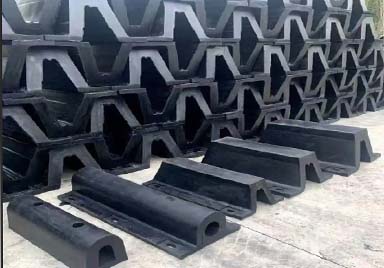
V-type (Arch) Rubber Fender | Arch/V-shaped structure, can be installed individually or continuously | Strong anti-shear performance, excellent adaptability for oblique berthing; balanced energy absorption & reaction force; stable performance under large-angle ship docking | Coastal general cargo terminals, ferry ports, ro-ro berths, medium & large container feeder docks |
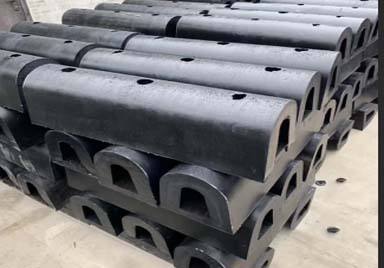
D-type Rubber Fender | Semi-circular D cross-section, pre-drilled base flange | Flat contact surface, low surface pressure, avoid scratching ship paint; easy installation, suitable for continuous arrangement | Yacht marinas, small fishing ports, inland river docks, low-tonnage barges |
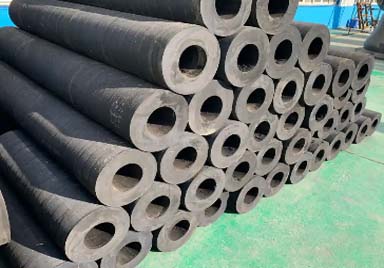
CY Cylindrical Rubber Fender | Round hollow cylindrical shape, horizontal or vertical suspension installation | Simple structure, cost competitive, flexible mounting method; convenient replacement for damaged single unit | Medium & small berths, dolphin protection, temporary ship-side protection, inland waterway terminals |
Pneumatic Floating Rubber Fender | Spherical inflatable air-filled rubber structure, equipped with tyre net protection | Floating freely with tide changes; outstanding flexibility; widely used for ship-to-ship transfer | Offshore ship-to-ship bunkering/transshipment, temporary vessel anti-collision, no fixed installation required |
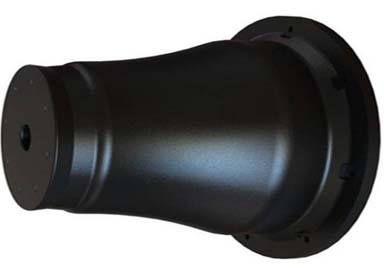
Cone Rubber Fender | Tapered cone shape, usually matched with frontal panel | Ultra-high energy absorption, low reaction force; keeps stable performance under large deflection; heavy-duty solution | Deep-water large-scale terminals, oil tanker, LNG and bulk carrier berths above 50,000 DWT |
Key Factors to Choose Suitable Rubber Fenders
1. Working Site: Fixed Dock or Vessel Temporary Protection
✅ Shore fixed installation (Port Berth)
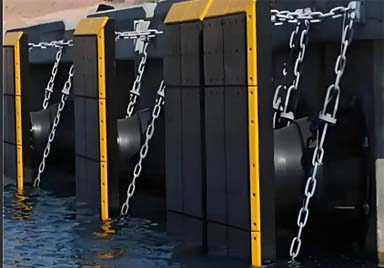
V-type, Cone, D-type and CY cylindrical fenders are the mainstream options, permanently bolted on quay wall.
The quantity, installation spacing and vertical layers are determined by berth length and tidal difference.
Large tidal range ports need multi-layer vertical arrangement to prevent collision at low water level.
✅ Temporary shipboard anti-collision
Pneumatic floating fenders are the preferred choice. They hang on vessel hull and float automatically following water level changes during ship-to-ship operation.
2. Vessel Condition: Tonnage & Berthing Speed
• Large ocean-going vessels over 50,000 tons, fast berthing speed: Recommend Cone fenders for high energy absorption.
• 3,000 ~ 35,000 tons bulk carrier / container feeder: V-type arch fender is the most universal choice.
• Inland barges, fishing boats, yachts below 5,000 tons: D-type or CY cylindrical fenders for cost control.
3. Berthing Habits & Berthing Angle
If vessels often berth obliquely at a large angle: Prioritize V-type arch fenders with strong shear resistance.
Ships mostly berth straight forward: Cylindrical and D-type fenders can meet demands.
4. Local Marine Environment
Seaports with high salinity, UV exposure: Adopt seawater resistant natural rubber compound to extend service life.
Order & Customization Support
Whale Marine supply all above rubber fender series, support customized dimensions, performance parameters and surface treatment. All products pass compression performance testing, meet international port standards and have been exported to European, Southeast Asian and Nordic ports.
We can provide professional calculation service: confirm fender model, single set specification and total required quantity according to clients’ berth drawing, vessel data and local hydrological conditions, to help buyers confirm order parameters efficiently.
E-mail : info@whalefender.com
Website : www.whalefender.com


Copyright © Whale Marine Product Co.,Ltd. All Rights Reserved | Sitemap| Powered by 