
How to Select Suitable Mooring Bollards: Materials, Shapes & Key Parameters for Marine Berthing
Marine mooring bollard is one of the most critical infrastructure for ports, terminals, marinas and ship decks. It bears the pulling force of vessels during berthing, anchoring and mooring operations, preventing ships from drifting caused by waves, currents and wind. The proper selection of bollards directly guarantees the safety of docks, hulls and marine staff. Improper specification matching will lead to overloading risk, rope breaking or even bollard fracture.
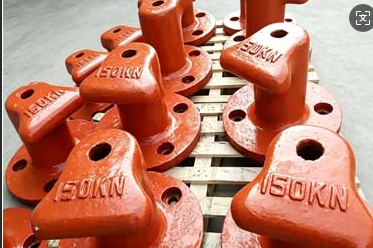
Main Types, Materials & Shape Introduction
1. Common Materials
1. Ductile Iron (QT450-10)
Most mainstream option for shore bollards. Good tensile strength, strong shock resistance, excellent corrosion resistance for coastal environment, cost-effective, widely adopted in commercial ports.
2. Cast Steel (Q235 / Q355)
High load capacity, suitable for super-large container terminals and heavy-tonnage vessels. Easy welding and processing; extra anti-corrosion coating is required.
3. Stainless Steel (316 Stainless Steel)
Premium choice for yacht marinas, offshore platforms. Outstanding seawater corrosion resistance. Higher price, mainly applied in luxury port projects.
2. Common Shapes & Application Scenarios
• T-head bollard: High load capacity, balanced force bearing, ideal for large commercial ports, container terminals.
• Staghorn bollard (Double horn): Can fix two mooring lines simultaneously, suitable for busy multi-vessel berthing areas.
• Tee head thin type bollard: Compact structure, saves space, fit for small ports, fishing terminals and marinas.
• Single bitt bollard: Simple structure, light load, widely used on ship decks and small jetties.
• Curve bollard / Horn bollard: Prevent mooring ropes from slipping, popular for yacht docks.
Technical Parameter Reference Table of Mooring Bollards
Bollard Model | Shape | Material Option | Rated Working Load (Ton) | Weight (Approx.) | Typical Application |
T16 | T-head | QT450 Ductile Iron | 16 | 125kg | Fishing port, small cargo pier |
T30 | T-head Thin Type | QT450 Ductile Iron | 30 | 176kg | Medium commercial port, barges |
T50 | T-head | QT450 / Cast Steel | 50 | 360kg | General cargo terminal |
T80 | Staghorn | Cast Steel | 80 | 620kg | Large container port |
S10 | Single bitt | Ductile Iron | 10 | 72kg | Yacht marina, ship deck |
Key Factors to Choose Mooring Bollards
1. Maximum tonnage of docking vessels
Calculate the maximum wind & wave pulling force to confirm rated load of bollards. Safety factor usually requires 3 times working load.
2. Water environment
Offshore sites with high salinity prioritize ductile iron or 316 stainless steel with anti-rust coating.
3. Installation space
Narrow piers select compact thin-type T-head bollards; large open terminals adopt staghorn bollards.
4. Foundation condition
Heavy-load bollards need reinforced concrete embedded foundation.
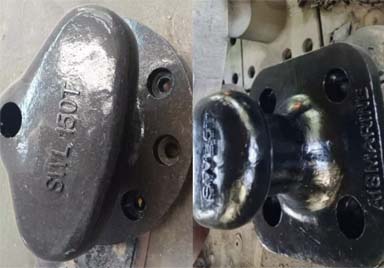
High-quality mooring bollards form the core guarantee of safe marine berthing. We supply full-series customized bollards with different shapes, materials and load levels. All products can be equipped with anti-corrosion painting, and support third-party inspection. Welcome global port operators, marine engineering contractors to consult for project solutions.
With the rich experience in marine industry for decades years,With the production plants based in china,WHALE MARINE provide worldwide delivery and serve the globally market to meet the customer’s demand from all countries.
E-mail : info@whalefender.com
Website : www.whalefender.com


Copyright © Whale Marine Product Co.,Ltd. All Rights Reserved | Sitemap| Powered by 